Something quite interesting happened in the compute space earlier this month. Larry Fink, CEO of BlackRock, said compute may become a tradable financial asset, with futures contracts emerging as demand for AI infrastructure overwhelms supply.
Speaking at the Milken Institute Global Conference in Beverly Hills, Fink argued that the world is already “short” on computing power, meaning there is not enough data centre capacity, chips, memory, or power to meet demand from AI companies and cloud providers. “A new asset class will be buying futures of compute,” he said, placing computing power alongside oil, grain, and natural gas as the kind of resource markets eventually need to price forward.
A week later that idea moved a step closer to reality. CME Group, the world’s largest derivatives exchange, announced it will launch the first compute futures market later this year, in partnership with Silicon Data, a GPU benchmarking firm backed by trading house DRW.
The contracts will settle against Silicon Data’s daily indices for on-demand GPU rental rates, giving AI builders, cloud providers, and investors a way to hedge against price swings in the underlying market for compute. CME’s chairman Terry Duffy described compute as “the new oil of the 21st century”.
A market built for the shortage we already have
At Theta, this is no surprise to us. Dealing with, and responding to, the compute shortage is a core part of our business model.
We are a decentralized neocloud that operates on a distributed compute model. We aggregate GPU capacity from a global network of community GPUs and combine it with traditional cloud GPUs through a hybrid orchestration layer, giving AI teams access to compute at a fraction of the cost of the major cloud providers.
Today that infrastructure powers research at institutions including Stanford, Imperial College London, KAIST, Yonsei, Seoul National University, NTU Singapore and the University of Oregon, and production AI workloads for sports and entertainment brands across the NBA, NHL, MLS and esports. We kind of saw this coming.
However, there’s a reason why this is interesting. And that’s what futures means for the future of compute scarcity, because the existence of compute futures makes the compute shortage even more real in a way it wasn’t before.
Why futures markets form, and why one is forming now
Futures markets usually appear when three conditions line up. The underlying resource is economically important. Future availability or pricing is uncertain. And there are natural buyers and sellers who want to transfer that risk between them.
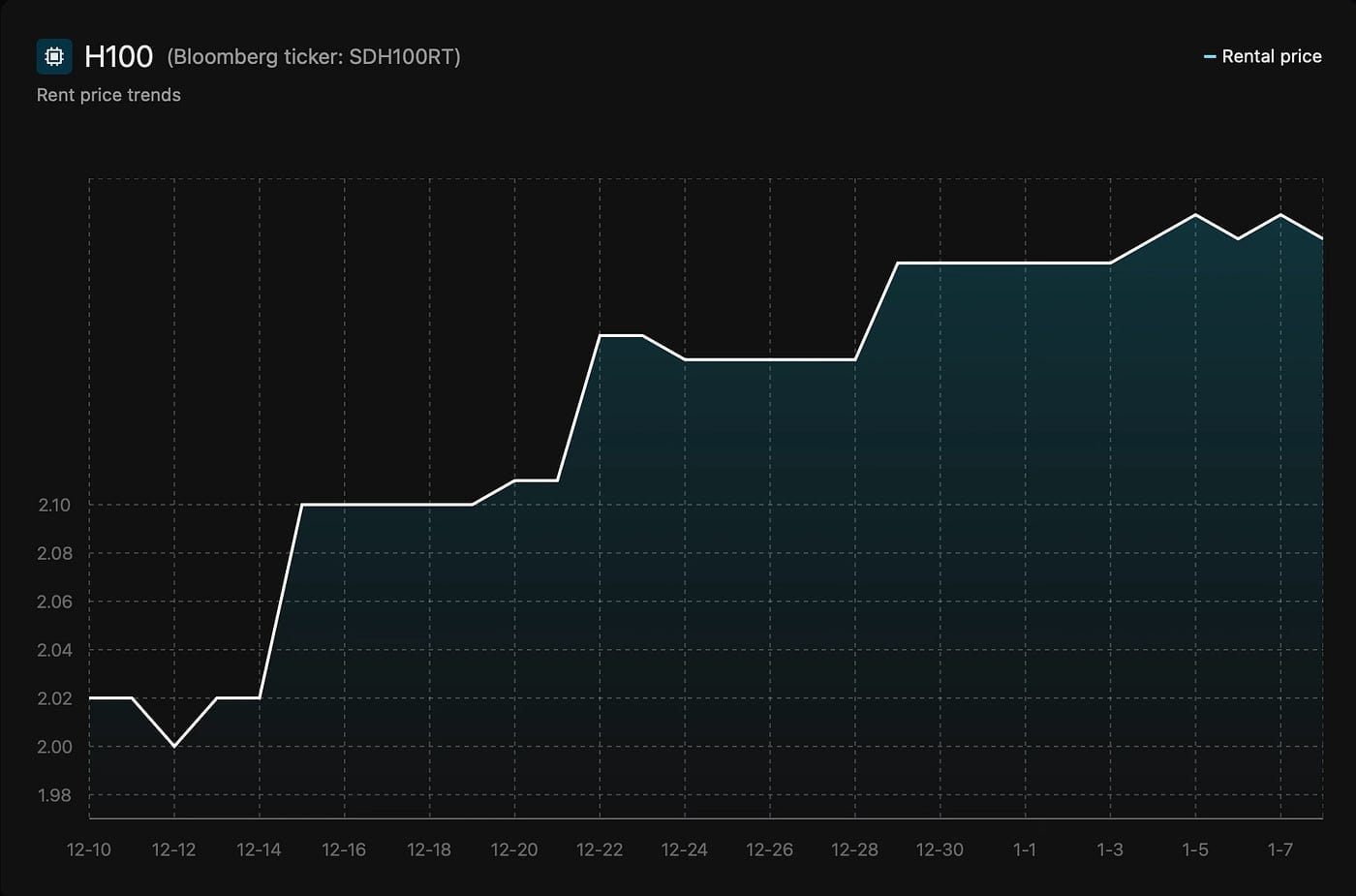
GPU compute now meets all three. It underpins the entire AI economy, from model training to inference to video generation. Its price moves around a lot, with rental rates varying dramatically by provider, region, and contract length.
And there are very obvious counterparties on both sides. AI companies and cloud customers want to lock in costs for workloads they know they’ll be running months from now. Infrastructure operators and capacity providers want to lock in revenue against future supply they’re building today. That is, in essence, the same logic that produced oil futures, electricity futures, and shipping freight futures before it.
It also says something quieter about where the market has got to. Futures contracts don’t really form around resources that are bespoke or relationship-priced. They form around things that have become commoditised enough to be standardised, measured, and traded. The arrival of a daily GPU benchmark, and a major exchange willing to settle contracts against it, is a sign that compute is crossing that line.
Pricing the shortage is not the same as solving it
It’s also worth being clear about what a futures market does and doesn’t do. It gives buyers a way to manage price risk. It does not produce a single extra GPU. A trader hedging compute costs in 2027 still needs someone, somewhere, to actually deliver the compute when the contract settles.
That problem, the physical one, is the harder problem. It gets solved by building more capacity, using existing capacity more efficiently, and bringing supply online from places the traditional cloud market hasn’t reached. Decentralized networks like Theta EdgeCloud are one answer to that. Hyperscaler buildouts are another. Both will be needed.
So when Larry Fink of BlackRock chimes in and says that demand for compute, and the need to access it at a stable price, will be so large that it will facilitate the creation of an entirely new financial asset, people should probably sit up and listen. Compute futures will help price the shortage. Platforms like Theta EdgeCloud are part of how the industry actually addresses it, by bringing more supply, from more places, into a market that clearly needs both.
This article is part of Theta’s Thought Leadership Series. To read more articles like this, subscribe to our blog.