For the past few years, the story of AI has been dominated by the pursuit of larger, more capable models. That progress produced remarkable results, but also shaped a particular view of AI infrastructure: massive training jobs running on clusters of the most powerful GPUs money could buy.
That mental model is becoming less useful.
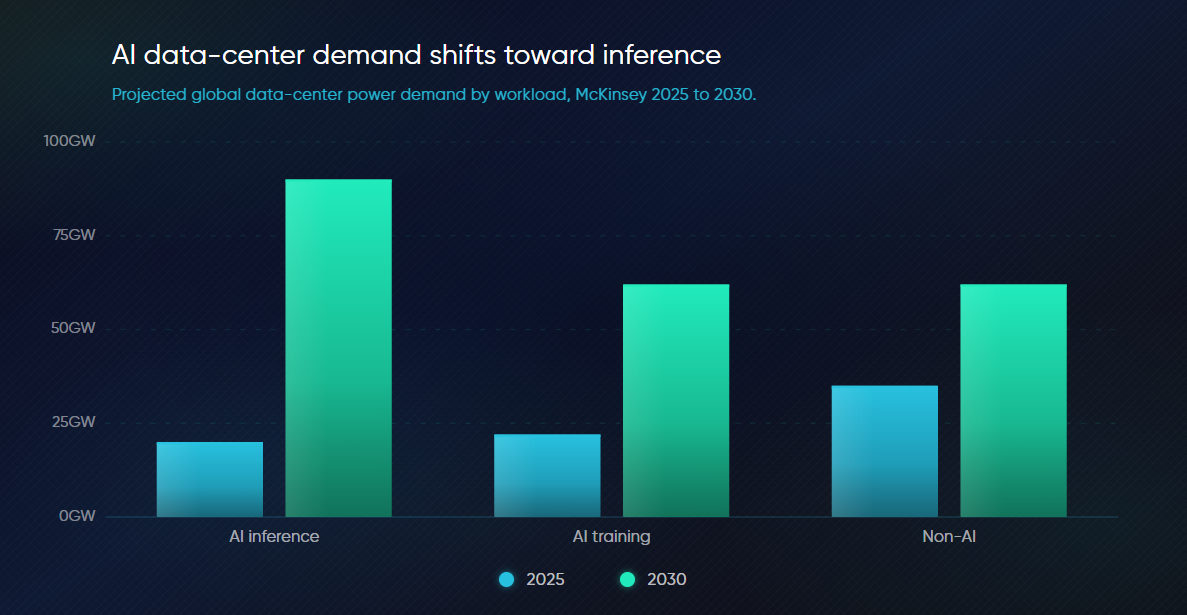
As AI usage increases and new users adopt AI tools, the centre of gravity in AI infrastructure is moving toward inference. Nvidia CEO Jensen Huang has predicted this since at least 2024.
PwC estimates that just 14% of global workers use generative AI every day at work. If you are reading this in 2026, you are still incredibly early to AI. As that usage grows, so does the compute required to serve it. The coming transition carries significant implications for the kind of compute that matters most.
From Building to Running
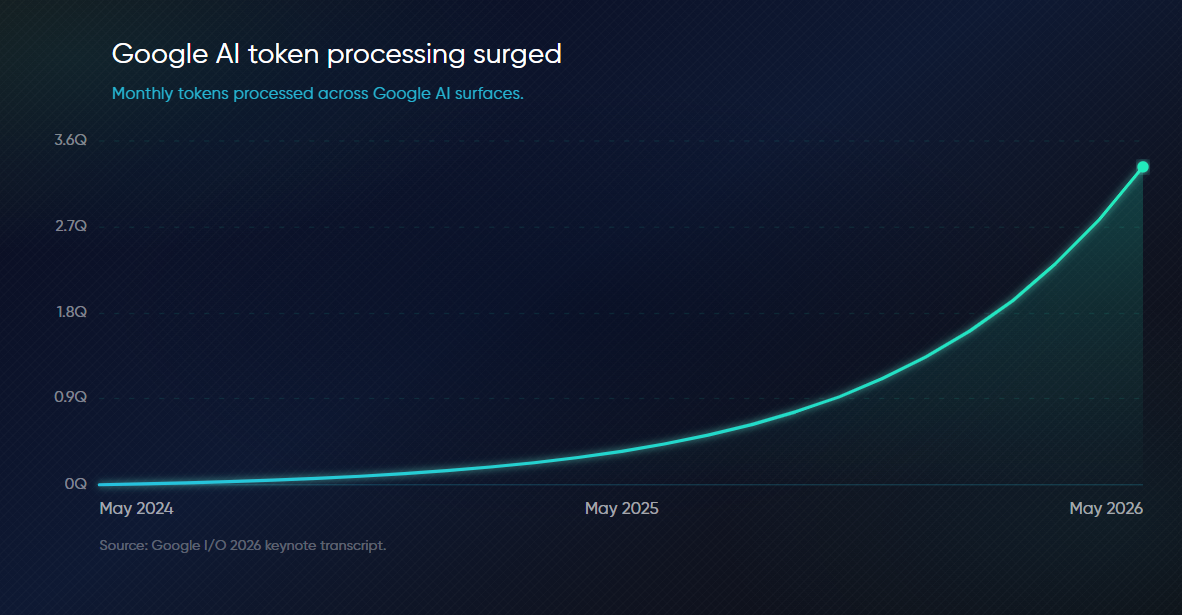
Inference is, in simple terms, the act of running a trained model. Every time a user sends a message to an AI assistant, every time an application generates a recommendation or processes an image, every time an autonomous agent takes a step in a multi-stage workflow, that is inference. It is the operational layer of AI, and it scales directly with usage.
Training happens in concentrated runs, whereas inference happens every time a model is used.
What is driving this acceleration is not just consumer AI applications but the emergence of agentic systems. Unlike a single query to a chatbot, an AI agent might make dozens of model calls to complete a single task, reasoning through different steps, checking outputs, retrieving information, and calling tools along the way. Each of those steps creates additional inference demand.
Agentic workloads also tend to be heterogeneous. One stage might require a large reasoning model, another a smaller specialised model, another an embedding model, and another an image or video model. Running every stage on the same premium GPU tier makes little economic sense.
As these workflows become more common across industries, inference becomes a continuous infrastructure requirement, and efficiently matching each workload to the right hardware becomes increasingly important.
The Hardware Mismatch
Here is where some of the assumptions inherited from the training era start to create problems. The GPU clusters that define much of the current cloud landscape were built around workloads where maximum compute performance is the priority. Frontier model training genuinely demands the highest-end data centre hardware available.
Inference is more varied. Different inference workloads place very different demands on hardware. Some are compute-intensive. Others are constrained more by memory capacity, memory bandwidth, latency, or the ability to process many independent requests efficiently. Even within large language model inference, different stages of serving a model can have different hardware characteristics.
That changes the economics of which GPU is actually appropriate for the job.
The most advanced data centre GPUs remain necessary for frontier model training and for demanding inference workloads. But a significant portion of inference, including serving small and medium models, running quantised or fine-tuned variants, processing parallelisable batch jobs, media generation, and powering individual stages of agentic workflows, does not require an H100 or H200.
The rise of open models is expanding the range of inference workloads that can run efficiently on RTX-class hardware. Models from partners such as Z.ai, alongside a growing number of smaller, specialised and quantised models, can increasingly be deployed without requiring premium data-centre GPUs.
Modern NVIDIA RTX GPUs are capable inference hardware for many of these workloads.
The important distinction is not between enterprise hardware and cheaper hardware. It is between workloads that genuinely require premium data centre GPUs and workloads that do not. Paying H100 prices for an RTX-sized problem is simply inefficient.
Distributed Infrastructure for a Distributed Workload
This is the structural opportunity that Theta EdgeCloud was built around.
Theta EdgeCloud combines community-operated NVIDIA GPUs, including a large base of RTX-class hardware, with enterprise-grade cloud infrastructure through providers including Google Cloud and AWS. Workloads can be matched to different classes of hardware based on what they actually require.
The result is a different cost structure from infrastructure built primarily around premium data centre GPUs. The aim is to match workloads to the hardware they require rather than paying for excess capacity. Click here to take a quiz to see what hardware is best for you.
Universities including Stanford, KAIST, Seoul National University, and Hongik University have adopted EdgeCloud for AI research and development. Hongik University has specifically highlighted the value of accessing RTX 3000- and 4000-series GPUs for workloads that do not require centralised high-powered GPUs.
Associate Professor Eun-Sung Jung of Hongik University said:
“Not all of our AI jobs require centralized high powered GPUs and that’s where EdgeCloud’s NVIDIA 3000s and 4000s GPUs are particularly attractive.”
Sports organisations including Olympique de Marseille and the Houston Rockets also run AI-powered fan applications through EdgeCloud. Not every production AI workload needs the most expensive GPU available.
The Economics of Right-Sized Compute
A developer choosing infrastructure for inference is increasingly making a cost-performance decision. How much throughput can a GPU deliver? How quickly can the model respond? How much memory does the workload actually require? And how much does each unit of useful inference ultimately cost?
For many workloads, the relevant comparison is no longer simply which GPU is fastest. It is which GPU provides the best performance for the amount being spent.
That is where RTX hardware becomes particularly compelling.
A modern RTX GPU may not replace an H100 for every workload, nor should it. But when a model fits comfortably within its memory footprint and the required throughput can be achieved, paying for additional data centre-class performance can become unnecessary overhead.
At scale, that difference compounds quickly. Thousands or millions of inference requests running on appropriately sized GPUs create a very different cost profile from running every request on the most expensive hardware available.
The same principle applies to agentic AI. If a workflow produces many independent model calls across different stages, the ability to route those calls across different GPU tiers becomes more valuable than simply having access to one extremely powerful class of hardware.
Where We Are Focusing Next
The inference shift is also changing what a competitive AI infrastructure platform needs to offer. Raw GPU access is becoming easier to source. What matters increasingly is the full stack around it: how quickly a model responds, how efficiently requests are handled, and how well the platform supports the iterative, branching patterns that agentic applications generate.
Our engineering focus reflects this. We are continuing to invest in the performance and reliability of our inference engine, with the aim of making EdgeCloud an increasingly competitive option for latency-sensitive, high-throughput workloads. We are building toward a more complete agentic AI platform, extending our existing deployments in sports and esports into a generalised capability that other verticals can access. And we are continuing to expand the network of edge nodes that makes our cost structure possible in the first place.
The models are built so the question now is who can run them well, at scale, without charging a premium for infrastructure that the workload does not actually need. That is the problem Theta EdgeCloud exists to solve.