This case study covers how a research team at Syracuse University used Theta EdgeCloud to support a new approach to generative AI, developed by Professor Junzhe Zhang and collaborators in the College of Engineering and Computer Science.
Generative AI models create images and other data by starting with random noise and gradually shaping it into something meaningful. The path a model takes to get there affects both training efficiency and the quality of its output. Zhang's team built a new way to design that path, drawing on how physics describes the movement of objects, and tested it on Theta EdgeCloud with support from the AWS Build on Trainium program.
The Research Challenge
Testing a new path-design framework against established baselines meant training multiple model variants and repeating experiments across three distinct data types, image, biological, and synthetic, under matched architectures and training budgets. That workload doesn't fit comfortably on the kind of shared, queued compute most academic labs have access to.
An Approach Inspired by Physics
The team's paper, "Lagrangian Flow Matching: A Least-Action Framework for Principled Path Design", was authored by Shukai Du and Yiming Li of Syracuse's Department of Mathematics, together with Professor Zhang of the Department of Electrical Engineering and Computer Science.
Their framework, Lagrangian flow matching, applies the principle of least action from classical mechanics, which determines the path an object follows between two points. The researchers applied that same idea to generative AI: instead of forcing models to follow straight paths between distributions, the framework lets them choose from a wider range of routes based on the characteristics of the data.
Existing flow-matching techniques fall out as special cases of the framework, which makes it a generalization of current methods rather than a replacement for them.
Infrastructure Behind the Experiments
The team ran its experiments on Theta EdgeCloud Hybrid, which pairs AWS Trainium instances with Theta's distributed compute network. Zhang's lab joined Theta's academic network in 2025 and has used that access for work spanning generative AI, causal inference, and reinforcement learning.
Running the same architectures, training budgets, and evaluation methods across synthetic, biological, and image datasets meant the team needed infrastructure it could allocate flexibly across three concurrent workloads rather than one fixed job at a time.
Results Across Three Research Areas
The team evaluated the framework on synthetic data, single-cell biological data, and CIFAR-10 image generation, using matched architectures, training budgets, and evaluation methods across all three to keep the comparisons fair.
On synthetic data, one version of the proposed method outperformed both baselines on three of four distribution pairs, and stayed competitive on the single-cell experiments. For CIFAR-10 image generation, the low-frequency OT-Harmonic model reached a Fréchet Inception Distance (FID) score of 3.681, a modest improvement on the 3.706 baseline under the same inference budget. Lower FID scores indicate better image quality.
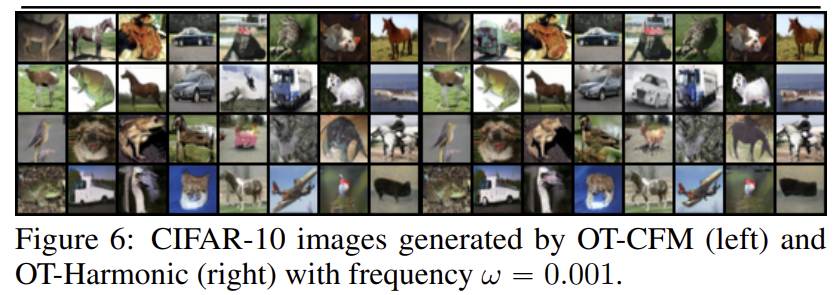
No single path worked best across every data type. Instead, the framework gives researchers a cheap, flexible way to choose paths suited to each problem, extending flow matching's straight-line baseline rather than discarding it.
"By leveraging AWS Trainium on Theta EdgeCloud Hybrid, we were able to experiment with innovative flow-based diffusion models that incorporate Hamiltonian dynamics for modeling complex text and image data. This infrastructure allowed us to rigorously compare new approaches with established diffusion and flow-matching methods, while also building reproducible and scalable implementations. We're particularly excited about open-sourcing our results and developing educational materials around AWS Neuron to support the broader research community."
- Professor Junzhe Zhang, Syracuse University
"Syracuse University's adoption of AWS Trainium on Theta EdgeCloud Hybrid demonstrates how decentralized AI infrastructure can deliver real-world value for advanced research. By combining next-generation AWS AI silicon with our hybrid cloud platform, we're expanding access to high-performance training environments beyond traditional GPU stacks."
- Mitch Liu, CEO and Co-Founder of Theta Labs
What's Next
Future work could let models learn the most suitable path directly from data, rather than selecting from a predefined family. The team also sees room to test the framework on larger workloads: higher-resolution image generation, text-to-image models, video, and molecular research.
Zhang's team's work shows how a principle from classical mechanics can open new possibilities in generative AI, and how flexible compute access can turn a theoretical idea into a working set of experiments across three very different research domains.
Read the paper, "Lagrangian Flow Matching: A Least-Action Framework for Principled Path Design", which is publicly available on arXiv.