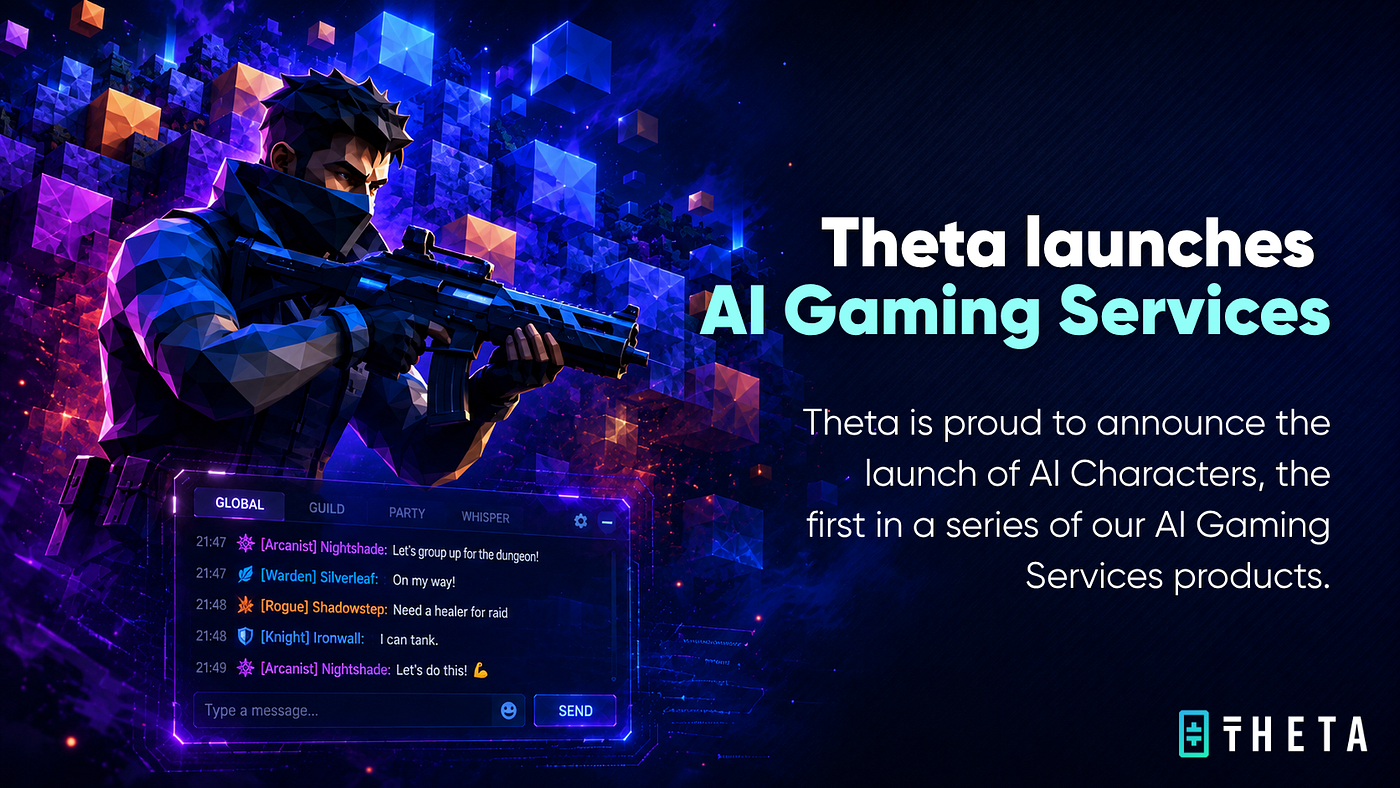
We are proud to announce today that Theta Labs is launching its AI gaming services vertical, and AI Characters is the first product built for it.
Why gaming, why now
In recent years, AI has become increasingly important, moving from an experimental phase into a visible, standard part of game development, shaping how studios design characters, build worlds, and iterate on player experiences.
The data backs this up. In GDC’s 2025 report, 52% of surveyed developers worked at companies that had implemented generative AI, and 36% said they personally used it in their own work. Adoption on the distribution side tells a similar story. By mid-2025, 7,818 Steam titles disclosed generative AI use, roughly 7% of Steam’s entire library, up from around 1,000 titles the year before. Close to one in five games released on Steam in 2025 disclosed some form of GenAI use.
Game studios are no longer asking whether generative AI belongs in their pipeline. They are asking how to use it well, and NPCs (non-playable characters) that interact with real players and the environment are one of the clearest places to start.
We’ve decided to enter that arena and put our best foot forward, but in a way that allows indie creators to fulfil their imagination too.
What AI Characters does
Our AI Characters tool gives game developers a way to add AI-powered NPCs to their games or interactive experiences. The whole system is built around a simple structure. You create a game, add characters to it, start sessions, and then send messages back and forth. Below is a concise explanation of what we’ve built!
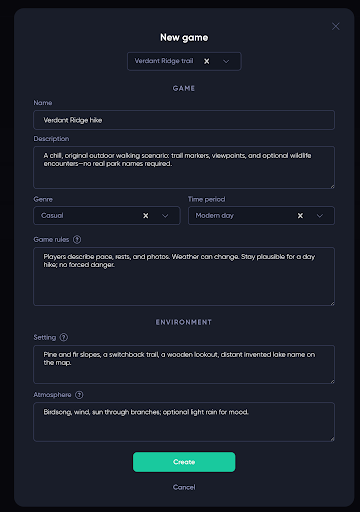
Create and manage games. A game is essentially the world your characters live in. You give it a name, a description, a genre, a time period, game rules, and an environment covering setting and atmosphere. This gives the AI the context it needs to make characters behave in a way that fits your world.
Create and manage characters (NPCs). Characters are tied to a specific game. For each one, you define details like name, age, appearance, personality traits, speaking style (formality, verbosity, vocabulary), background, goals, and even what the character does or doesn’t know. Preset templates are available for common archetypes such as a detective, a bartender, or a professor, so teams can get started quickly rather than building every character from scratch.
Create and manage sessions. A session is a single play instance. You choose which NPC characters take part, add user participant IDs, and set the context for the scene, including situation, location, and time of day. Multiple sessions can run in parallel for the same game, which matters for studios testing different narrative branches or supporting many concurrent players.
Send messages in a session. Once a session is running, you can send different message types: regular chat messages, actions, or events. Chat and action messages must come from a user participant rather than an NPC, keeping the distinction between player-driven and character-driven input clear. Participants can also be added or removed mid-session.
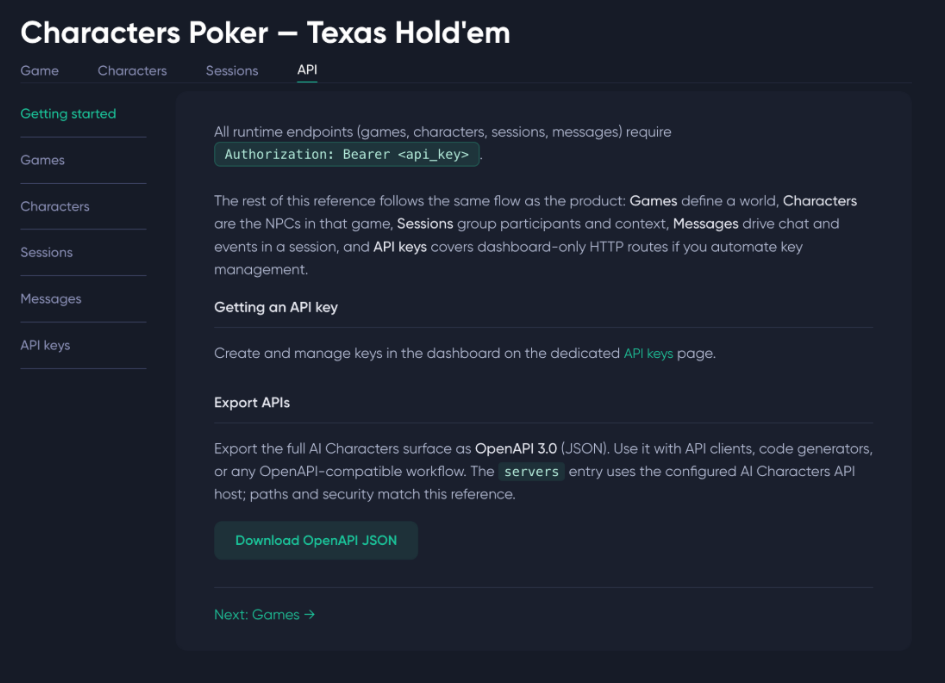
Manage API keys. The service authenticates runtime calls using Bearer tokens. Developers can create, list, and delete API keys directly from the dashboard, which also auto-provisions a default key when needed.
Access built-in API docs. A full API reference lives directly in the dashboard, showing available endpoints, offering cURL examples for each one, and letting developers export the complete OpenAPI spec as a JSON file to plug into their own tooling.
The poker demo
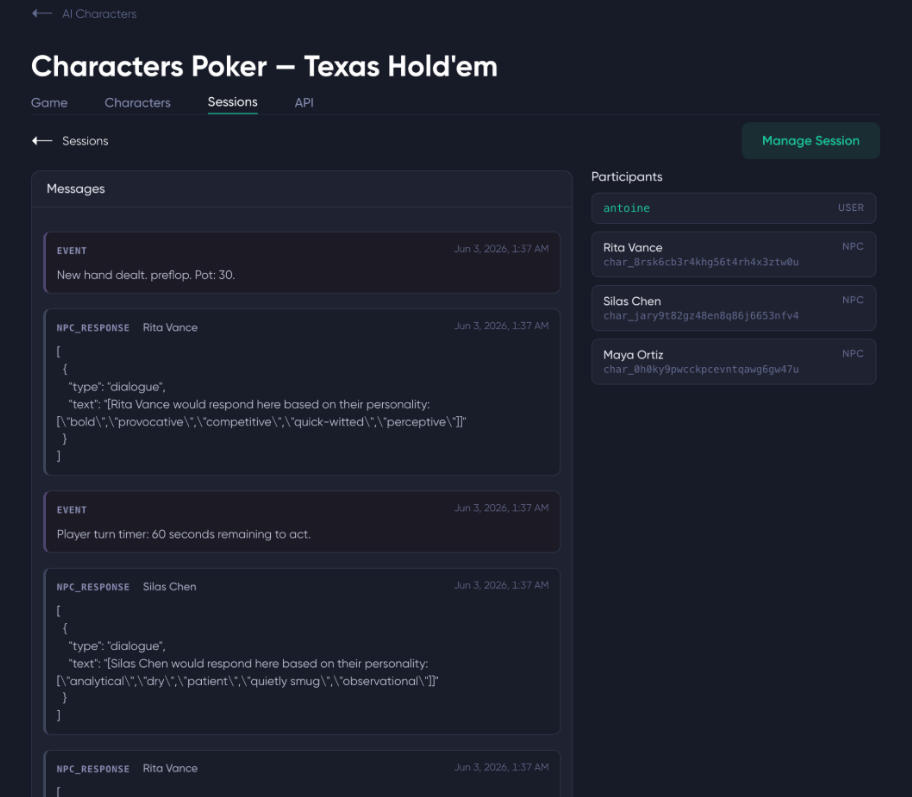
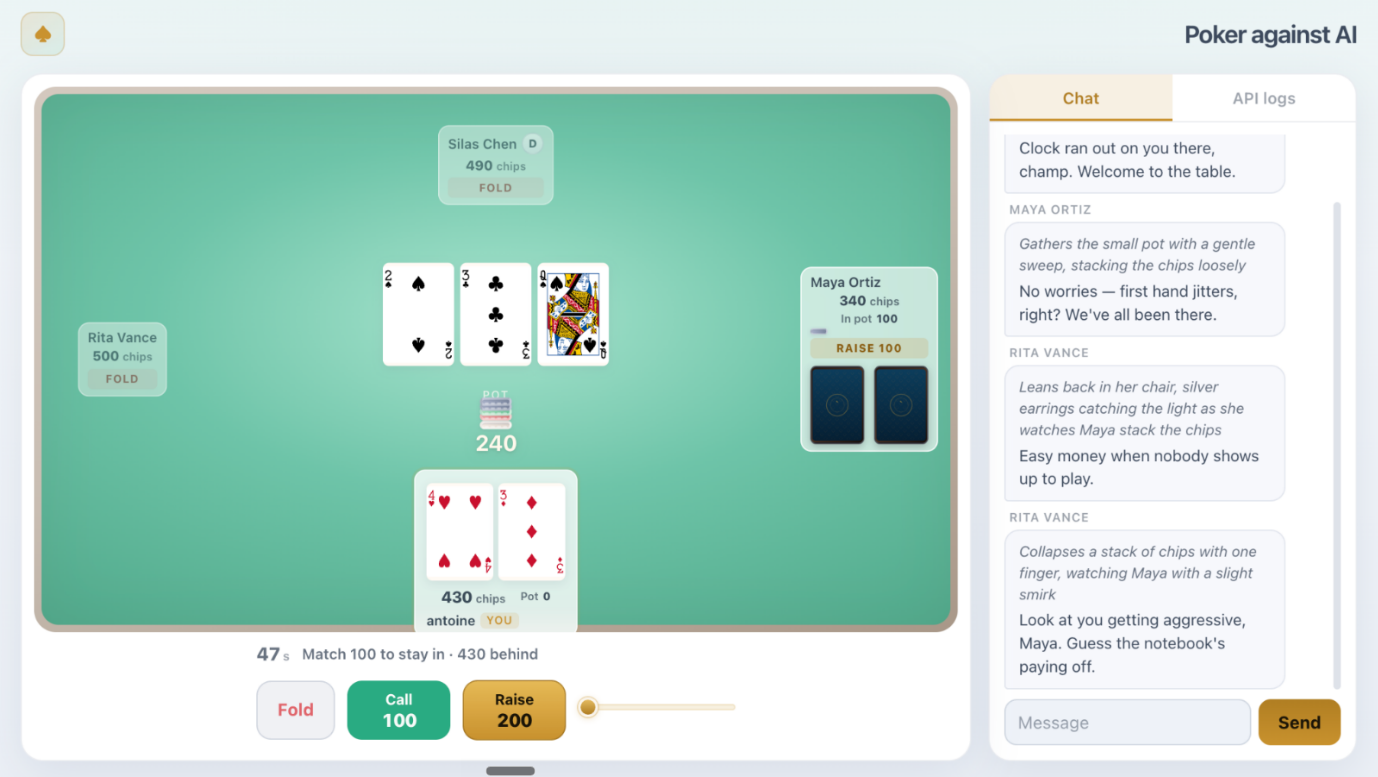
To show AI Characters in action, we built a poker demo where players sit down against computer-controlled opponents with real personalities. The aim is for each opponent’s personality to stay consistent throughout a game and to remember its interactions with the player, adjusting its behavior accordingly as the session goes on.
Setting this up starts on the AI Characters page, where users create a game that dictates the context for how characters get generated. Presets are available to try out immediately, or the game can be fully customized. From there, users set the personality of each character they want to add, giving them the traits, background, and speaking style that shape how they play and how they talk.
You can see AI Characters in action through our Poker game example: ai-game-demo.thetaedgecloud.com
A long time coming
We are incredibly proud of the team who has been working on this for many months. We first announced our intentions to launch gaming services a couple of years ago, and since then the team has been hard at work making that vision a reality. AI Characters is the first product to come out of that effort, and it reflects the same infrastructure principles behind Theta EdgeCloud: flexible, distributed, and built to give developers real control without unnecessary overhead.
We are constantly expanding what Theta Labs can do, and gaming services is the newest chapter in that story. We are looking forward to seeing what developers build with AI Characters, and to sharing more from this vertical soon.