Theta EdgeCloud runs enterprise GPUs that genuinely earn their place for the most ambitious workloads. But not every job needs top-end hardware.
There’s a reflex in AI infrastructure to reach for the largest, most powerful GPU on the market, as if raw scale were the only signal of a serious workload, and it’s an easy default when every benchmark and every launch cycle centers on the newest flagship part.
AI workloads do not need one oversized compute profile. A distributed cloud can match each job with the right infrastructure, from rentable NVIDIA RTX GPUs for inference, fine-tuning, media generation and prototyping to AWS Trainium accelerators for cost-efficient model training at scale. The result is better hardware utilisation and more practical economics for real AI workloads.
Right-sized compute at a glance
- 01
NVIDIA RTX GPUs
Inference, fine-tuning, media generation and prototyping
- 02
AWS Trainium
Cost-efficient model training at scale
- 03
AWS Inferentia
Serving models efficiently at production scale
- 04
Enterprise GPUs
The most ambitious workloads, such as frontier LLM pretraining
Hardware That Fits You Like a Glove
Pretraining the next generation of frontier large language models is genuinely constrained by memory bandwidth and interconnect at a scale only enterprise-class hardware can address. The heaviest, longest-running agentic workloads at production scale tend to hit similar limits, even though lighter local agent work runs well on RTX-class hardware. That work is real, and it needs serious infrastructure behind it.
The point here isn’t that big GPUs are unnecessary, it’s that most AI & media workloads aren’t bottlenecked the same way, and sizing hardware to the actual constraint is what determines how fast a project actually moves.
What RTX-Class Hardware Is Actually Built For
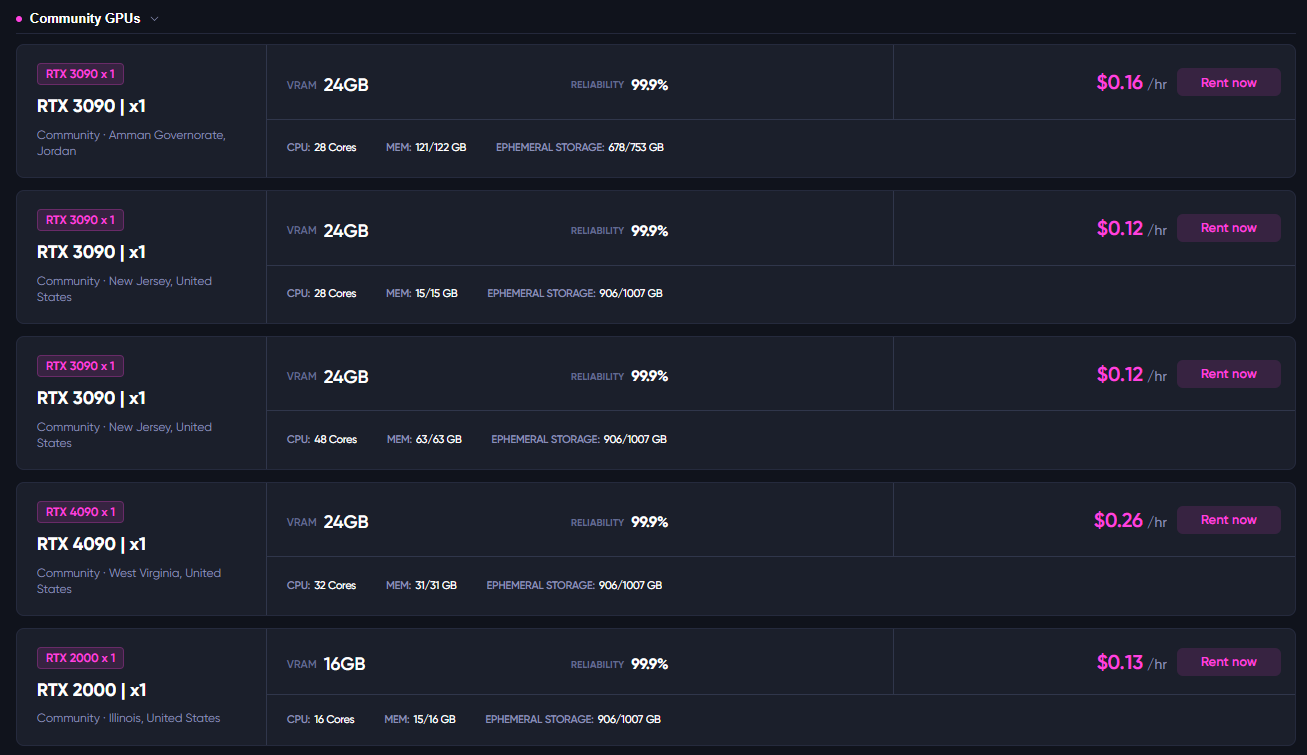
Modern RTX GPUs bring real, current silicon to a wide range of production workloads. Rendering complex 3D scenes, encoding and finishing video on dedicated NVENC and AV1 hardware, generating images and video at production quality, running LoRA-style fine-tuning jobs, and serving inference at moderate scale are workloads these cards are built for.
A studio serving an AI agent inside a game, a small team generating concept art at production resolution, or a developer running a live inference endpoint are all better served by hardware sized to that workload than by hardware built for a different problem entirely. Cards with more VRAM in the fleet take on larger scenes, bigger batch sizes, and heavier fine-tuning runs particularly well, while cards further down the stack are well matched to streaming, transcoding, and lighter inference workloads.
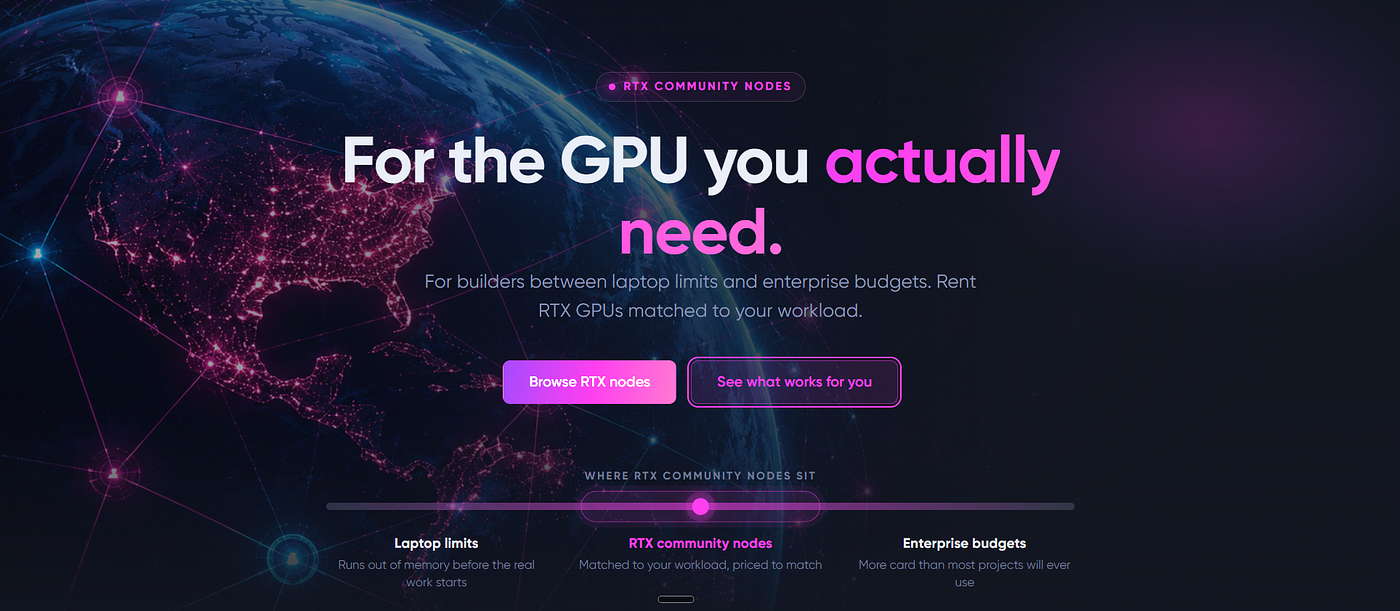
For Teams Already Building on AWS
Theta EdgeCloud also offers access to AWS Trainium and Inferentia chips, AWS’s own silicon for training and inference, built around the Neuron SDK with PyTorch integration. Trainium is built for distributed pretraining and fine-tuning at scale, and Inferentia is built for serving models efficiently at production scale. Both give AWS-native teams purpose-built economics without leaving the stack they already use.
Matching the Hardware to the Work
We built a short quiz to help make choosing the right hardware easier. Answer a few questions about what you’re building, whether that’s an AI agent running inside a game, a fine-tuned model, or a production inference pipeline, and it’ll point you to the GPU tier actually built for it.