October began with a new collaboration bringing EdgeCloud into stadiums and venues, and ended with a look at what happens when software starts acting on its own.
In between, Alibaba Cloud chose Theta EdgeCloud to bring its Qwen models to Web3 developers, and our academic network in Korea grew again. Here's everything that happened.
Theta Labs and Weaver Labs to Collaborate on AI and Edge Infrastructure for Stadiums and Venues
We opened the month by announcing a collaboration with Weaver Labs, the London-based provider of private 5G, connectivity and edge infrastructure software for stadiums and venues. Weaver Labs will use Theta EdgeCloud as a decentralised AI compute resource for Cell-Stack, its edge and connectivity platform, supporting low-latency inference directly on-site. Cell-Stack already powers AI analytics, multi-angle streaming and a fan assistant across the 30,400-seat Stadium MK, and the two companies will explore joint solutions that pair Weaver Labs' connectivity with Theta's distributed GPU infrastructure.
Excited to announce a strategic partnership between Weaver Labs & @Theta_Network! 🤝⚡
— Weaver Labs (@Weaver_Labs) October 7, 2026
We’re combining Theta’s decentralised GPU network with Cell-Stack’s on-site connectivity software to give venues a complete platform for AI. pic.twitter.com/Wvnd7QzuRX
Alibaba Cloud Brings Qwen to Theta EdgeCloud
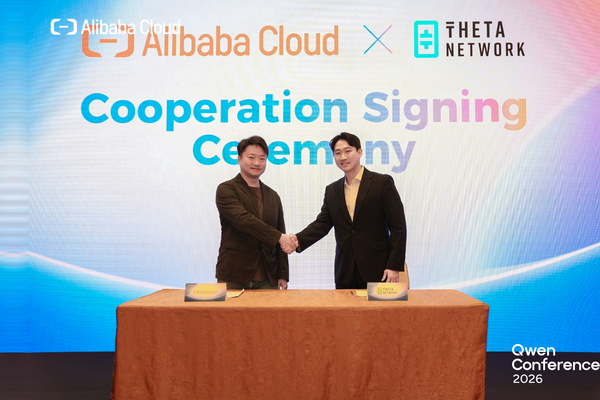
Alibaba Cloud selected Theta EdgeCloud as its decentralised AI distribution platform, bringing Qwen models and related AI services to Web3 developers worldwide. Qwen3.8-Max and Qwen3.8-Flash are now available on EdgeCloud, in one of the first instances of a major global cloud provider offering its frontier models on a decentralised GPU network. The partnership was marked with a signing ceremony at Qwen Conference 2026, and the two teams plan to bring more Qwen models and AI services to EdgeCloud in the coming months.
Made it official, in person. Asia Pacific’s largest cloud provider is bringing @Alibaba_Qwen to Theta EdgeCloud.
— Theta Network (@Theta_Network) October 2026
Kookmin University's AI Vision Lab Joins Our Academic Network
We welcomed the AI Vision Lab and Professor Youngwook Kim at Kookmin University in Seoul to our global academic network. The lab builds vision models that learn reliably from incomplete or noisy data, with work spanning satellite imagery, autonomous driving and medical imaging. Professor Kim's CVPR 2022 paper, Large Loss Matters in Weakly Supervised Multi-Label Classification, showed how models start memorising noise in partially labelled images, and proposed simple methods to prevent it. Kookmin adds another leading Seoul institution to EdgeCloud's growing presence in Korea.
Kookmin University’s AI Vision Lab has joined Theta EdgeCloud’s academic network.
— Theta Network (@Theta_Network) October 2026
The Web Is Starting to Run Itself
We closed out the month with a new thought leadership piece on the rise of the autonomous web. With traffic from AI agents growing 7,851% in 2025 against 3.1% for human traffic, the piece looks at how agents are increasingly researching, paying and provisioning compute for themselves, why blockchain laid the rails for it, and how agents can already discover and deploy GPUs on Theta EdgeCloud on their own.
AI agent traffic grew 7,851% last year.
— Theta Network (@Theta_Network) October 2026