
When a fan asks an AI agent a question, the quality of the answer depends almost entirely on what the agent retrieves from its knowledge base. The model powering the agent matters, of course, but the retrieval step is where most failures actually happen. Pull the wrong content, or a vague chunk of mixed text from a large document, and even a capable model will give a poor answer. Fix the retrieval, and the answers improve dramatically.
This is the problem PageIndex is designed to solve, and it is now available across Theta EdgeCloud AI agents.
Why Retrieval Breaks Down on Structured Content
Most knowledge bases used by sports teams, esports organisations, and gaming brands are not simple collections of FAQs. They contain guides, rule sets, strategy documents, news archives, and long-form content with clear internal structure, where a specific section answers a specific question.
Traditional retrieval systems don’t respect that structure. They slice documents into fixed-length text blocks, retrieve whichever block scores highest against the query, and hope the relevant information made it in. Often it doesn’t, or it arrives buried inside irrelevant context that muddies the final response.
What Pageindex Does Differently
PageIndex indexes documents at the section level, so each guide section, article, or rule update becomes its own retrievable unit. When a user asks a specific question, the agent pulls the specific section that answers it rather than a broad chunk from somewhere nearby.
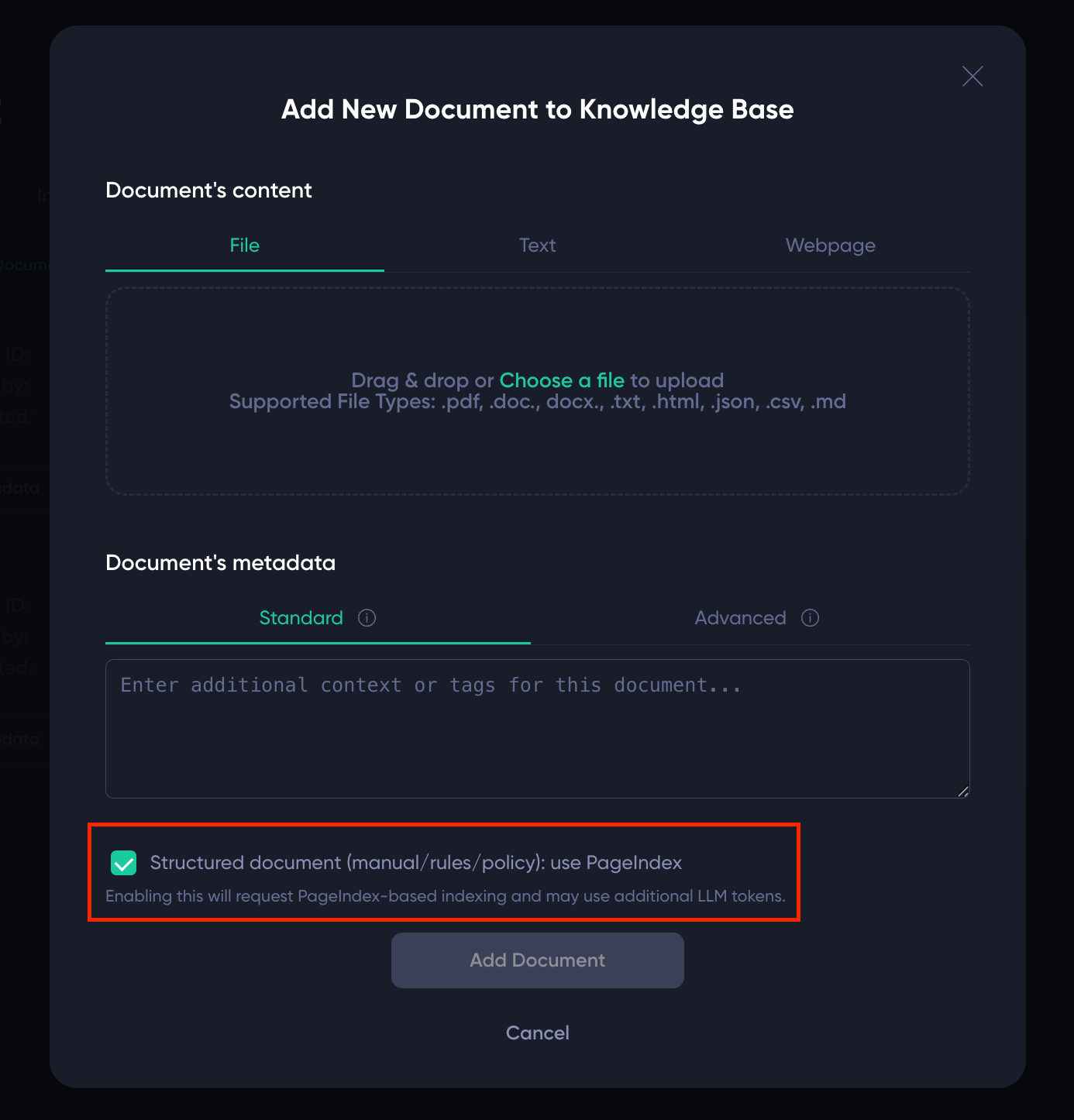
It uses a routed approach: PageIndex activates only for queries that clearly match structured document content, leaving the standard retriever to handle everything else. General knowledge base performance stays intact while structured content becomes significantly more usable.
What the Numbers Look Like in Practice
We benchmarked PageIndex with Method, the esports organisation and longtime home of elite World of Warcraft strategy content. On a set of structured guide questions, accuracy under the original retrieval setup came in at 25%, three correct answers out of twelve. With PageIndex, that rose to 83%, ten out of twelve, while general knowledge base performance held steady at 70%.
The one tradeoff worth naming is latency. The best-performing configuration averaged around 7 seconds on structured queries compared to roughly 3.6 seconds on the standard setup. For most use cases, that is an acceptable exchange for a threefold accuracy improvement on the questions that matter most.
What This Means if You’re Considering an Edgecloud AI Agent
Theta EdgeCloud AI agents are already handling thousands of fan interactions daily across major sports teams and global brands, answering questions, resolving queries, and keeping audiences engaged around the clock. The organisations running them know that an agent is only as useful as the answers it gives.
If your knowledge base consists primarily of short, discrete Q&A content, standard retrieval already performs well. But if you hold long-form structured content, whether that is game guides, venue and ticketing documentation, player histories, support knowledge bases, or regulatory archives, PageIndex is where that content finally becomes reliably usable. The agent finds the right section of the right document rather than approximating from the nearest available chunk.
Getting retrieval right across diverse knowledge bases requires more than one approach. PageIndex is part of how we make sure the right tool is applied to the right content.
If you are thinking about what an EdgeCloud AI agent could do for your organisation, we would be glad to show you what that looks like in practice. Contact us at [email protected]