Theta EdgeCloud now accepts TDROP as a payment method for compute services across the platform. Starting today, developers, researchers, and enterprises can use TDROP to pay for GPU compute, AI model training and inference, API calls, and other EdgeCloud workloads.
This is a significant step in TDROP’s evolution from its original role as an NFT marketplace token into a broader utility token that connects AI users, developers, and infrastructure providers across the Theta ecosystem.
What This Means for EdgeCloud Users
Users can now select TDROP as a payment option when purchasing EdgeCloud services. This applies across the platform’s full range of compute offerings, including on-demand GPU access, pre-configured AI model endpoints, video processing, and containerized workloads.
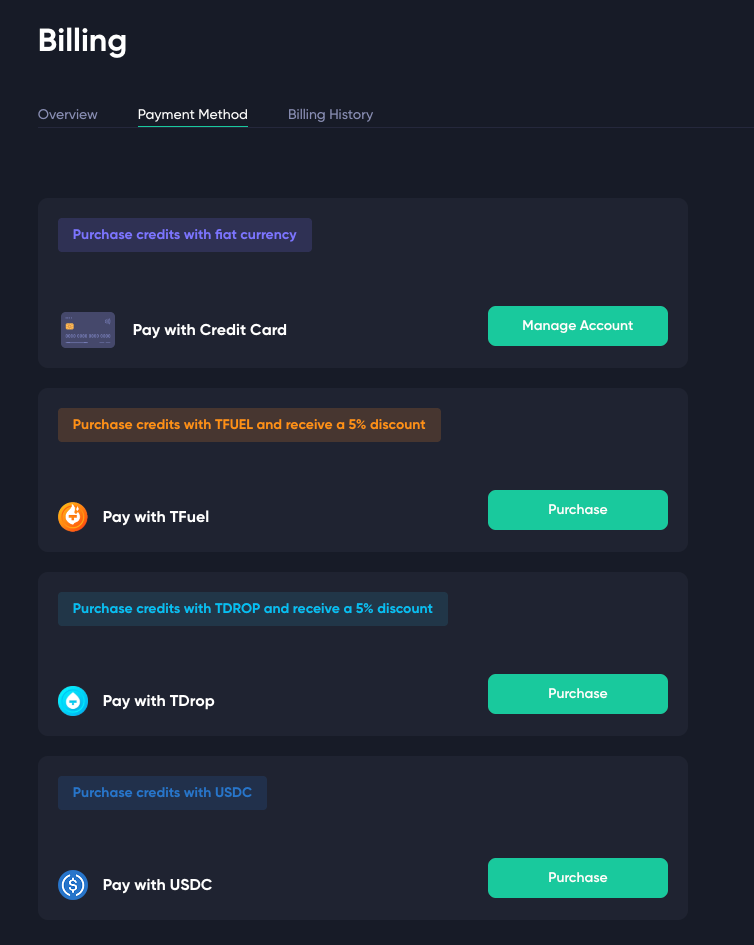
TDROP joins TFUEL and fiat as accepted payment methods on EdgeCloud, giving users more flexibility in how they pay for compute. TFUEL continues to function as the gas token for all on-chain transactions and base-layer blockchain operations, while TDROP operates at the application layer as a payment and incentive mechanism tied to AI and compute activity.
Part of a Broader TDROP 2.0 Expansion
The addition of TDROP payments on EdgeCloud is part of the TDROP 2.0 initiative outlined in the 2026 roadmap. Under this expansion, TDROP is being repositioned as a multi-utility token designed for the growing AI compute economy. Beyond payments, the roadmap includes developer rebates of 5–10% in TDROP for EdgeCloud usage, user reward programs tied to AI agent engagement and commerce activity, and the groundwork for agent-to-agent transaction settlement as autonomous AI systems become more prevalent.
Up to 500 million TDROP has been allocated from the existing Theta Labs reserve pool for reward and rebate activities. No new tokens are being minted. The total TDROP supply remains fixed at 20 billion.
Why TDROP on EdgeCloud
Theta EdgeCloud serves a growing base of academic and enterprise customers, including Stanford University, Imperial College London, KAIST, Seoul National University, Yonsei University and NTU Singapore. These users rely on EdgeCloud’s hybrid architecture, which combines over 30,000 distributed edge nodes with cloud partnerships from Google Cloud and AWS, to access GPU compute at significantly lower cost than traditional providers.
Adding TDROP as a payment option creates a tighter loop between token utility and platform usage. Developers who earn TDROP through rebates can apply those earnings directly toward future compute costs. Users who accumulate TDROP through engagement rewards can put them toward EdgeCloud services. The goal is a self-reinforcing cycle where platform activity generates real, usable value for participants.
How the Token Ecosystem Works Together
Theta Network operates with three tokens, each serving a distinct function.
THETA is the governance token used for staking as Validator or Guardian nodes that secure the network. TFUEL is the operational gas token that powers on-chain transactions, smart contract execution, and base-layer network activity. TDROP now serves as the application-layer token for AI compute payments, commerce rewards, developer rebates, and ThetaDrop marketplace governance.
This layered structure keeps blockchain gas economics separate from application pricing. EdgeCloud compute costs remain stable in TDROP terms regardless of network congestion or gas fee fluctuations on the base layer.
Looking Ahead
The second half of 2026 will bring additional TDROP utility, including the rollout of usage-based rebates for EdgeCloud activity and expanded reward programs connected to AI agent interactions. TDROP staking rewards have also been extended through February 2030 following a governance vote, with 4 billion TDROP reallocated from the original NFT liquidity mining pool to fund continued staking incentives.
This is the beginning of a broader shift toward building sustainable economic feedback loops around decentralized AI infrastructure. As EdgeCloud adoption grows and AI agents become more capable of autonomous activity, TDROP is designed to serve as the connective layer between users, developers, and the compute resources that power their work.
To start using TDROP for EdgeCloud services, visit thetaedgecloud.com.