Theta EdgeCloud is our GPU compute network, connecting traditional data centre hardware with thousands of community operated nodes around the world. It gives developers, enterprises and research teams access to compute for AI training and inference, often at a fraction of traditional cloud pricing. The network is already live, handling real workloads today rather than building toward some future launch.
Here is a short explanation of what that means for our token holders.
Training vs. Inference
The public conversation about AI infrastructure is dominated by training large models. When a lab builds a new model, they assemble enormous GPU clusters, feed in vast datasets, and run the process for weeks or months.
The hardware required is expensive, the energy consumption is significant, and the resulting model is a fixed artefact with a fixed endpoint. The weights are set, the model exists, and that particular phase of compute is finished.
Everything that happens after that point is inference.
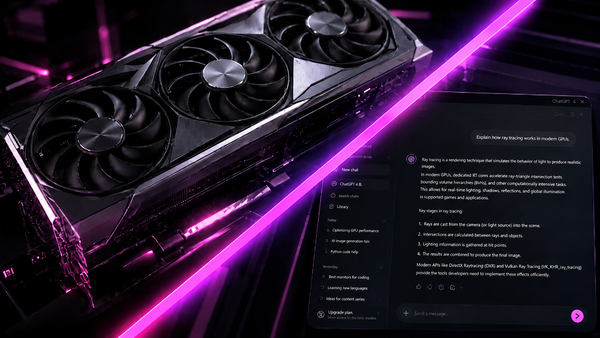
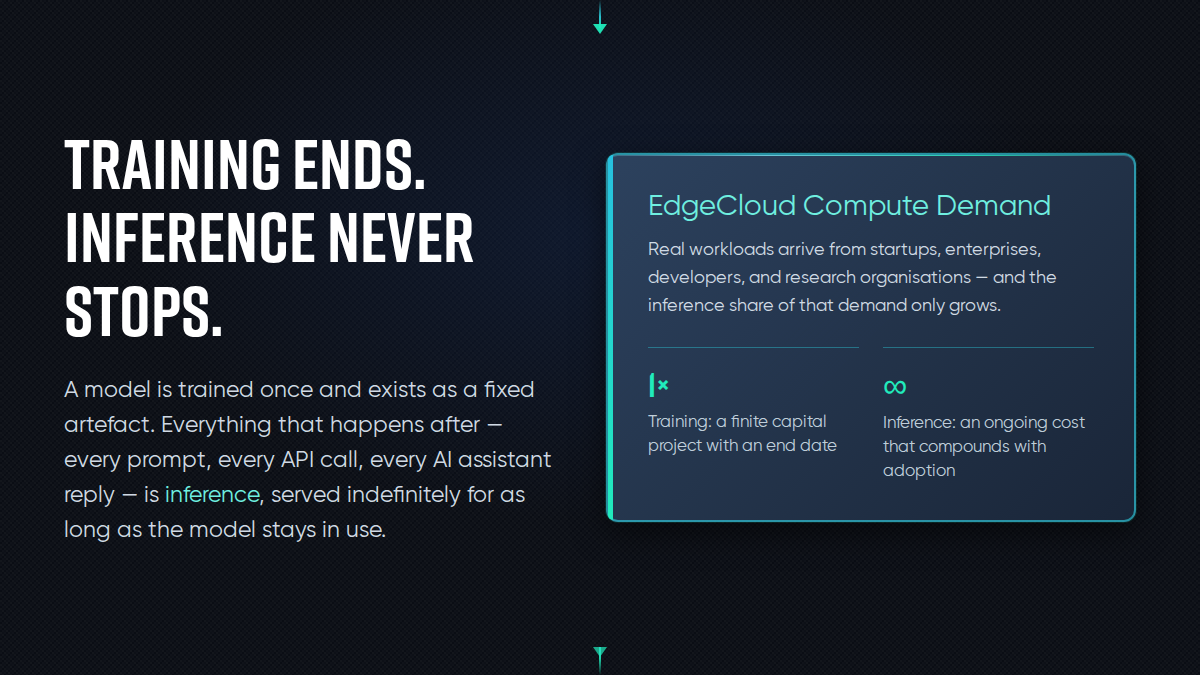
When you ask ChatGPT a question, that is inference. When a developer’s application calls a model API, that is inference. When a business deploys an AI assistant that handles thousands of customer queries a day, every single one of those responses is inference. Training created the model once, at a specific moment in time. Inference serves it to the world indefinitely, for as long as the model remains in use, and that window can stretch for years.
Unsurprisingly, the vast majority of AI compute is for inference, and is only expected to grow.
This distinction matters because the compute economics are completely different. Training is a capital project with a defined end date — it finishes when the model is ready.
Inference is an ongoing operational cost that scales with adoption and compounds over time, growing in proportion to every new product built on top of the model and every new user those products acquire. The infrastructure requirement that has no natural ceiling is not building models but running them, continuously, at whatever scale the market demands.
Why Inference Runs Well on Distributed Hardware
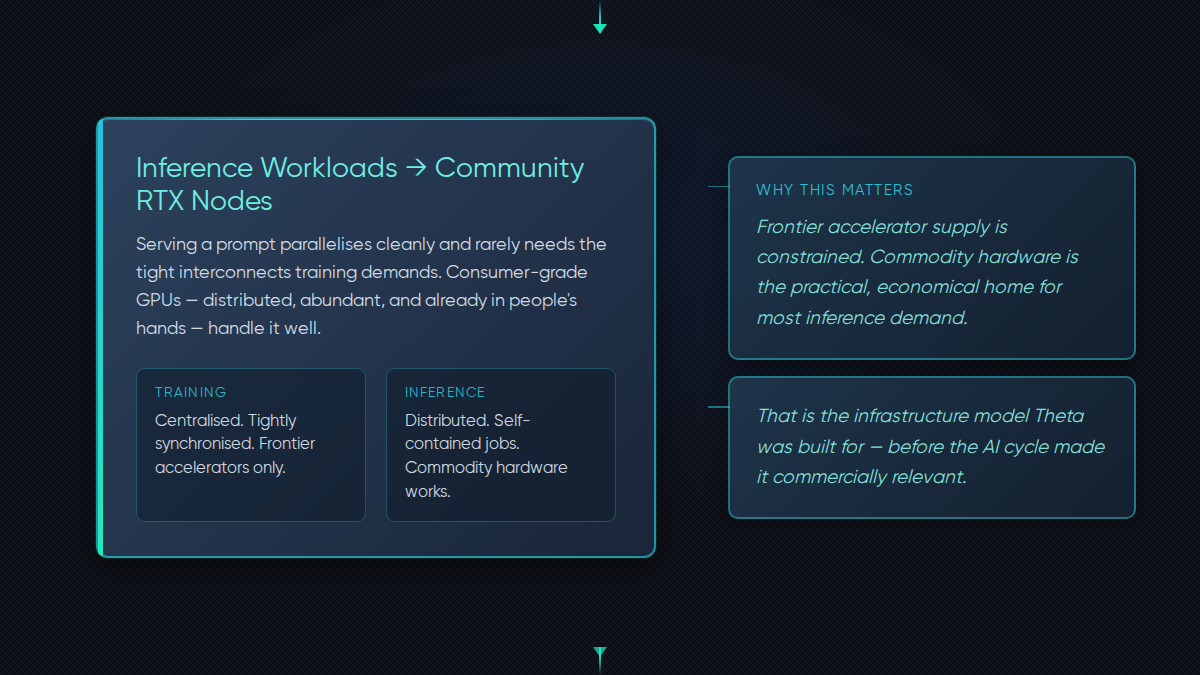
Training at scale requires tight coordination between GPUs. The calculations involved in updating model parameters across billions of weights are deeply interdependent, which means the hardware needs to be co-located, connected by high-speed interconnects, and synchronised with precision.
This requirement pushes frontier training toward large, centralised, proprietary clusters. Inference does not carry the same requirements.
Serving a prompt to a deployed model can be distributed across many independent machines without the tight synchronisation that training demands, because the work parallelises cleanly and each inference request is largely self-contained. Consumer-grade GPUs — the kind that millions of people already own as gaming hardware, and that we have on our network — handle inference workloads well, and they are abundant, geographically distributed, and a fraction of the cost of frontier accelerators.
As inference demand grows and frontier accelerator supply remains constrained, the most practical and economical home for the majority of inference workloads is a distributed network of capable, commodity hardware — and that is precisely the infrastructure model that Theta was designed to provide.
The Community Layer
Theta’s EdgeCloud network includes a layer of community-operated nodes running NVIDIA RTX cards, and this layer exists because the founding insight behind Theta was always that useful compute is distributed across the world in the hands of people who are willing to contribute it. These are Theta community members who have invested in hardware, connected to the network, and made their compute available for real workloads — participants in a distributed infrastructure that the original vision for Theta anticipated before the current AI cycle made it commercially relevant.
That insight is now being validated commercially. Inference workloads land well on RTX hardware, the economics work for both the customer and the operator, and the community node layer functions as genuinely productive infrastructure rather than a theoretical proposition. Startups building AI-native products, fast-growing enterprises deploying internal AI tools, developers building on foundation models, and research organisations running generative AI experiments — none of these customers necessarily require B200s.
What they require is reliable, cost-effective inference at scale, and that is what community RTX nodes can provide as the supply of frontier accelerators remains limited relative to the demand for inference capacity.
How Revenue Becomes Token Demand
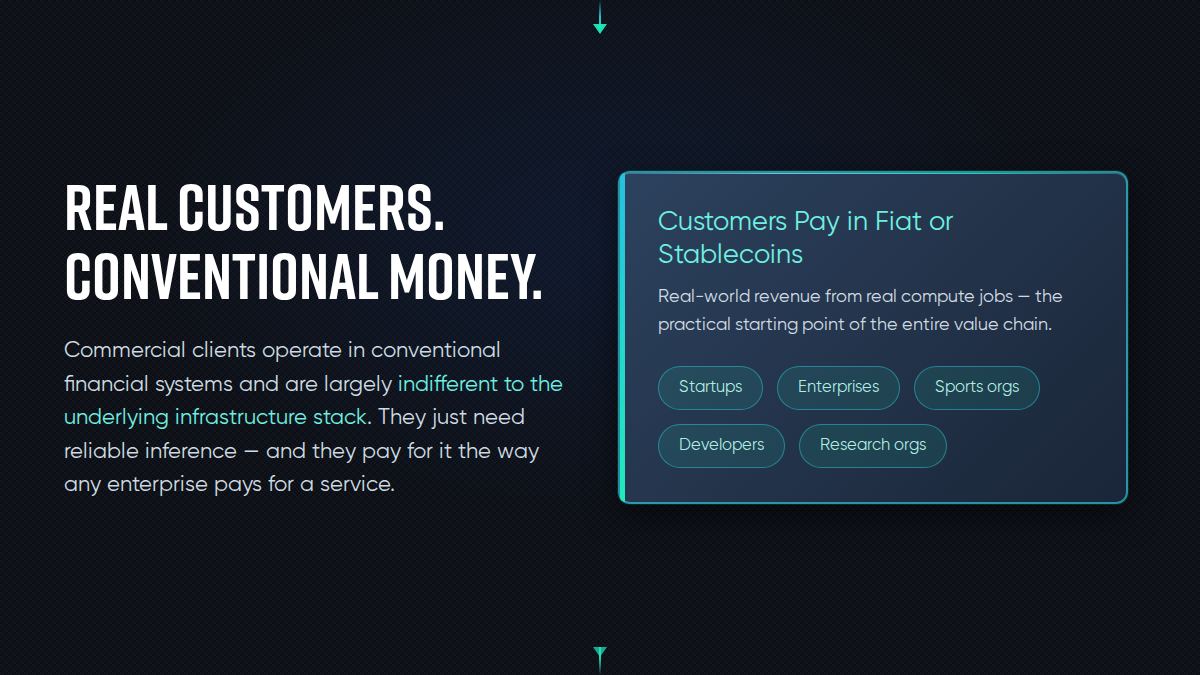
EdgeCloud customers — startups, enterprises, sports organisations, developers, and research organisations — largely pay for compute in fiat currency or stablecoins, which is the practical reality of working with commercial clients who operate in conventional financial systems and are often indifferent to the underlying infrastructure stack.
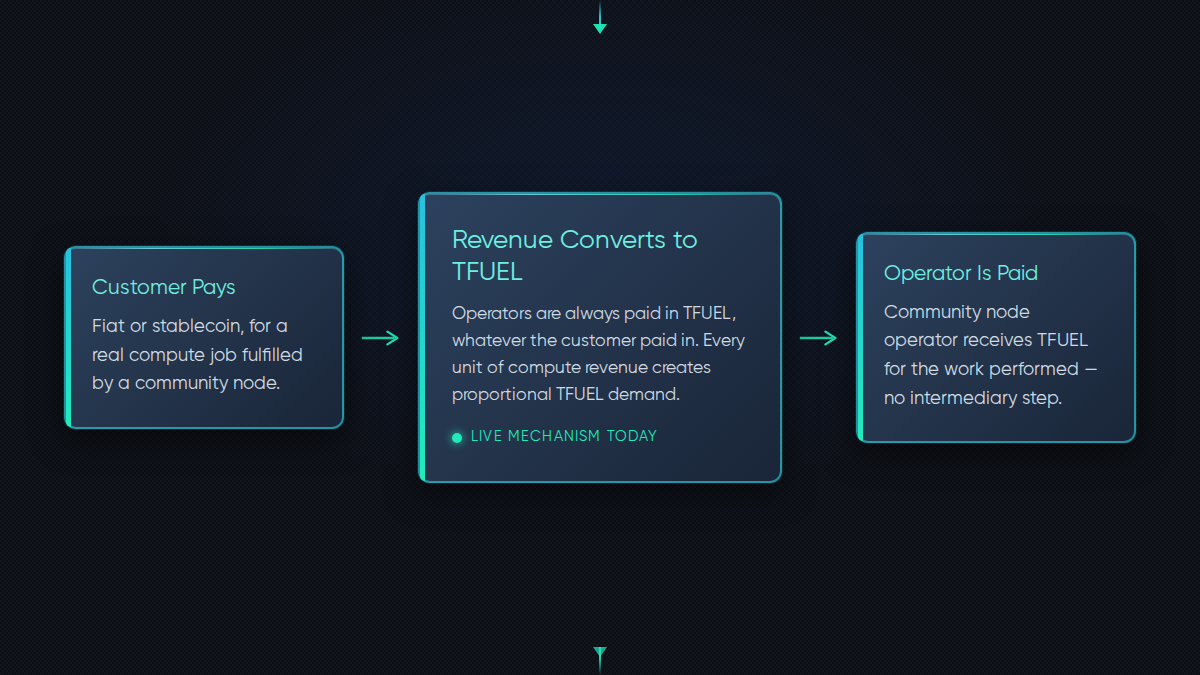
When a customer pays for a compute job fulfilled by a community node, that revenue is converted into TFUEL to compensate the operator. Node operators are always paid in TFUEL, regardless of how the customer originally paid, and this conversion is not a planned feature on a roadmap but the live mechanism today.
The relationship this creates is direct and proportional: every unit of real compute revenue that flows through EdgeCloud to community nodes generates a corresponding demand for TFUEL, with compute revenue and TFUEL demand scaling together and no intermediary in between.
TFUEL, THETA, and Where Value Sits
TFUEL is the operational token of the Theta network, and every compute job, every node payment, and every on-chain transaction runs through it. As EdgeCloud routes real compute revenue to community node operators in TFUEL, that token gains genuine economic utility grounded in commercial activity — demand that originates not in speculation but in the actual work of serving AI workloads to paying customers.
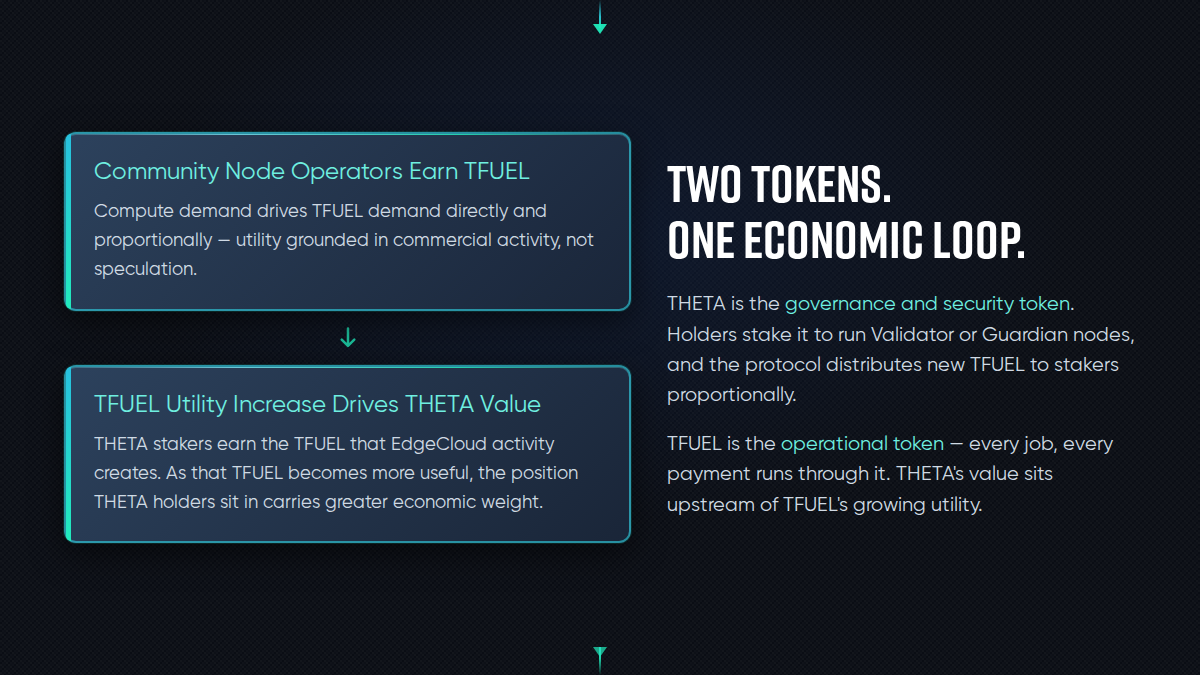
Theta runs a dual-token system, and the relationship between the two tokens is worth understanding clearly. THETA is the governance and security token: holders stake THETA to run Validator or Guardian nodes, which secure the network, and in return the protocol generates new TFUEL and distributes it to stakers proportionally. THETA stakers are the people earning the TFUEL that EdgeCloud compute activity creates, which means the dual-token structure connects network security directly to network utility in a single economic loop.
As EdgeCloud grows and TFUEL becomes more useful and more in demand, the TFUEL that THETA stakers earn carries greater economic weight. THETA’s position in this structure is upstream of TFUEL’s utility — it represents a stake in a network whose operational token is tied to real, growing compute revenue.
The Full Picture
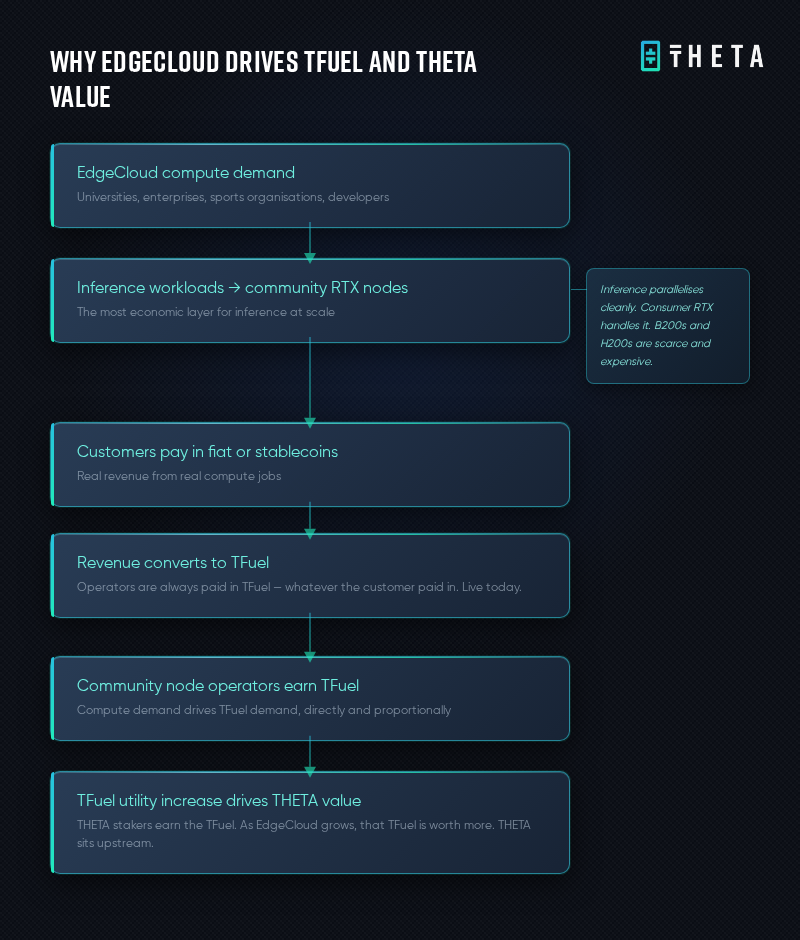
Real customers pay for real compute, which is served by community-operated RTX nodes run by Theta community members, whose operators are paid in TFUEL, with the demand for that TFUEL scaling in proportion to the compute demand that created it — and THETA stakers are the people positioned to earn it.
The more economic activity flows through the network, the more meaningful that position becomes.
The conversion mechanism is live, enterprises and research organisations are already using EdgeCloud, and community nodes are already serving workloads and being compensated in TFUEL. The infrastructure is in place, and what comes next is a question of how much of the world’s growing inference demand finds its way to a network built, from the beginning, to serve it.
To use Theta EdgeCloud for your startup, enterprise, or research organisation, simply click here. Pay only for what you use.